01One wallet. Every Kaspa asset.
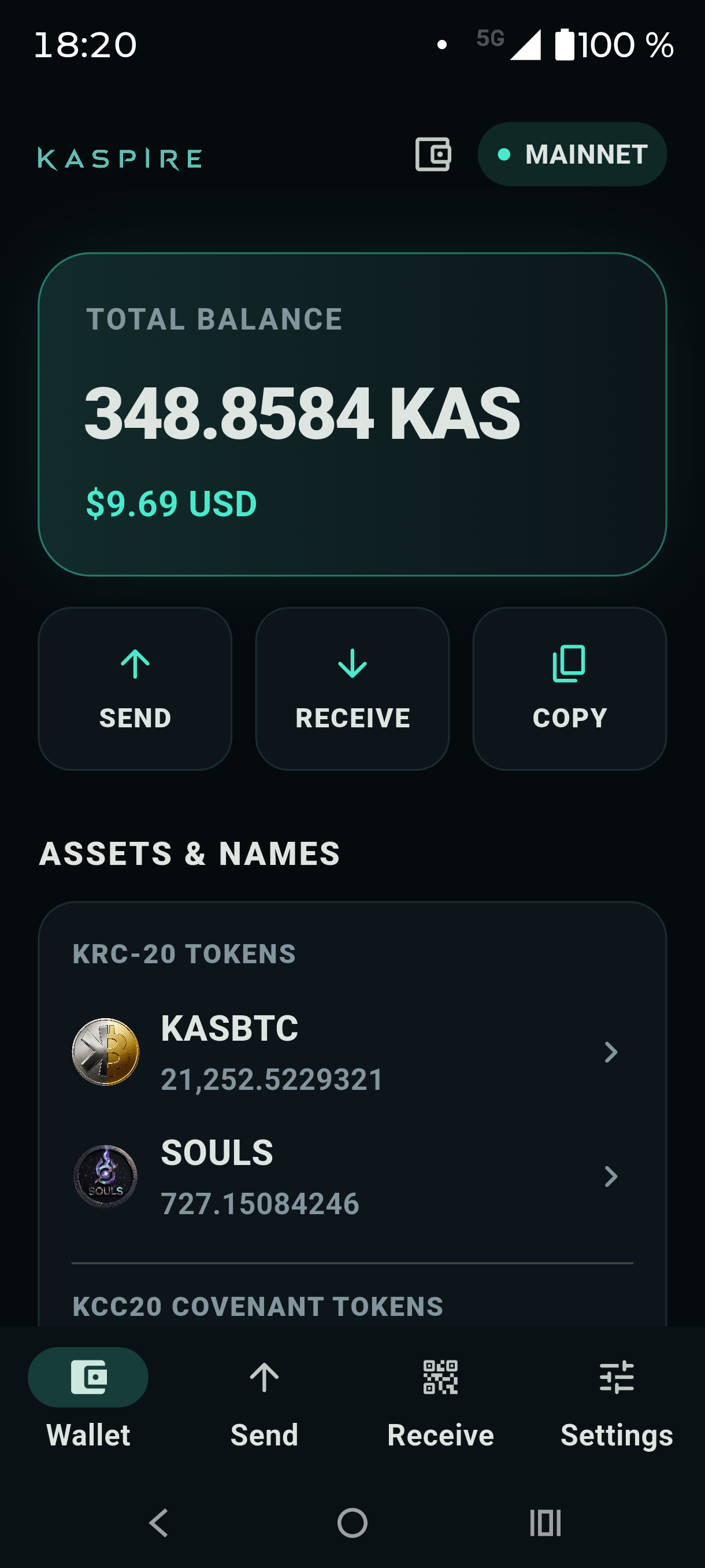
Hold and move KAS, KRC20, KRC721, KNS, KCC20, and Kasplex/Igra L2 assets. Android and the browser extension support the pinned KCC20 reference profile, with own-node cell checks and independent local covenant validation.
KASKRC-20KRC-721KNSKCC20
02Native signing, human review.
Transactions are reconstructed in a pinned Rust core. Recipient, value, change, fee, mass and token state are bound to what you approve.
Rust coreReview hashFail closed
03Built for real wallet history.
A rich activity feed opens every transfer in-app with sender, recipient, asset data, fees, inputs, outputs, DAA score and transaction ID. Android and the extension load independent sources progressively, start with the latest 50 entries and add 50 with Load more. Verified KCC20 token units take precedence over legacy display fallbacks. Extension swaps show your wallet's actual KAS balance change, with pool and covenant movements separated into expandable transaction details.
ActivityTX detailsLocal node
04Connect without surrendering control.
Scan a dApp's WalletConnect QR code directly inside Kaspire, inspect its verified origin and permissions, and manage active encrypted sessions. Every signature still needs fresh approval.
In-app QR pairingWalletConnectPer-request approval
05Accounts and subwallets that travel with your seed.
Modern and legacy BIP-44 discovery restores both separate accounts and KasWare-compatible address-index subwallets under one recovery phrase.
111111Legacy 972AccountsSubwallets
06Keep UTXOs under control.
See your wallet's UTXO count and consolidate fragmented KAS outputs through a reviewed, authenticated self-transfer. Android and the browser extension support verified KCC20 configurations with up to ten token inputs and outputs; existing tokens retain their own contract limits. Larger payments use a reviewed, resumable whole-payment plan. Standard KCC20 and KaspaRocket transfers can reuse an eligible recipient cell through Borrowed Receive, preserving its tokens, receiving policy and KAS deposit. A new receiving cell is used when no eligible one can be verified.
UTXO countKCC20 consolidationFee preview
07Kaspa L2 networks, one familiar wallet.
Switch between Kaspa Mainnet, TN10, Kasplex and Igra while keeping the same wallet identity, receive flow, asset layout and native review model.
Kasplex L2Igra L2EVMNative review
08Your wallet. Your style.
Choose Neptune's turquoise ocean and water-glass panels, Glacier's aurora crystal glass, or HUB21's brushed gold and silver. Keep controls readable and find tokens and names in alphabetically sorted asset lists. Available in Android and the browser extension.
NeptuneGlacierHUB21A–Z assets
09Pay a name. Verify its owner.
Find your dot.k covenant names alongside your other assets. Enter a .k name to send KAS or assets on Layer 1: Kaspire derives its deed in Rust and checks live ownership through the node before selecting the payment address. Android and the browser extension include K-Agora: list, buy and cancel dot.k name sales through native sale covenants, with a 10 KAS minimum price and a 2.1% marketplace fee. Network fees are separate.
dot.k namesRust verificationLayer 1 payments
10NFTs meet K-Agora.
Choose NFT Market, dot.k Market or Nexus Offers inside K-Agora. Android also brings KaspaCom Marketplace directly into K-Agora for KRC721, KRC20 and KNS, with its own orders and fees. List, buy and cancel Kaspire KRC721 NFT listings through decentralized seller-signed PSKTs, without operator escrow. Submit private, non-binding offers, negotiate counter offers and receive wallet notifications without locking funds. Nexus Offers on Android and the browser extension recognizes both Kaspire and KaspaCom PSKT listings, with cached price lookups. The extension links KaspaCom listings to the specific NFT on KaspaCom. Search collections, filter traits and sort by price, recency or collection rarity rank with ten items per page. Images and available rarity ranks come from Kaspire's read-only NFT gateway with an official-indexer emergency fallback; transaction checks continue through the official indexer. Kaspire settlements include a 2.1% marketplace fee; network fees are separate.
NFT MarketPSKT listingsCollection filtersRarity ranks
11Keep dApps inside your wallet.
Open approved sites directly in Kaspire Browser on Android. Choose Kasvio, Kasseal, GothDAG, dot.k, Kaspa News, Kaspa Dev Tools or KasCoven Vaults, in that order. Supported dApps keep WalletConnect connection and transaction approvals inside Kaspire; Kaspa News is a read-only news entry. Browser navigation is restricted to approved origins.
In-app browserApproved dAppsWalletConnect
12Mainnet DEX swaps, inside your wallet.
On Android and in the browser extension, choose KaspaRocket, Kasseal or KRON under Swap to trade supported mainnet covenant tokens. Kasseal supports exact 1,000-token bonding-curve lots and whole-token constant-product pool swaps after graduation, with launch-proof verification, token preparation and a separate swap history. KaspaRocket token details show your balance, price and value with separate Send Asset and Swap buttons. Review covenant IDs, wallet flows and fees before local signing. Signed swaps are encrypted for recovery; uncertain broadcasts remain saved.
KaspaRocketKassealKRON DEXMainnet swaps
13Receive KAS with a hidden spending key.
Open Receive KAS and switch to P2SH account on Android or the browser extension. KIP-22 P2SH addresses keep the spending public key off-chain until you spend their outputs. Review amounts and fees locally, use Max with automatic fee deduction, and receive change at a fresh P2SH address. This separate Mainnet KAS account requires a seed-based HD wallet and an up-to-date encrypted backup. It reduces public-key exposure, but does not make Schnorr signatures quantum-resistant.
P2SH accountKIP-22Hidden public keysFresh change
14Your wallet beside your dApp.
Use the split-window button in the extension header to open Kaspire in Chrome's Side Panel beside the current website. It is optional: the normal extension popup stays the default. Supported dApp connection, unlock and signing reviews appear inside the matching open panel, with the same explicit approval and native checks. Without a matching panel, Kaspire uses its ordinary approval popup.
Optional Side PanelIn-panel approvalsSame wallet